
Live-in care not only benefits those being cared for but has additional benefits for families. Choosing the right care for your parents or relatives can be a difficult decision. However, Mumby’s know from experience that those who choose live-in care for families over a nursing home will also enjoy benefits they may not have even thought of.
Relieve the guilt
 By choosing live-in care, you avoid the trauma of moving your parent or loved one into unfamiliar surroundings, particularly if they do not want to move. With live-in care they can remain at home giving you the peace of mind that they are safe and well cared for.
It might be that live-in care is a short-term solution before they go into a nursing-home but if/when that time comes you will know you did everything you could to keep them in their home for as long as possible. We know the process of choosing live-in care as a solution goes a long way to removing any doubt or guilt when that decision has to be made.
Better at Home
The Better at Home report in December 2016 looked at two major concerns in the health of older people, falls and hip fractures. The findings conclusively show that people who have live-in care are less likely to fall, and far less likely to have a hip fracture than people in residential and nursing homes. The study also showed people receiving live-in care have higher levels of happiness with ‘softer’ positive outcomes; they enjoy the sense of freedom and independence that’s maintained. You can be reassured that research shows a live-in care solution is not only a safer option but one that will have more positive effect on your parent/loved one.
 Further and more recent research from The Live-in Care Hub’s 2023 Care Choice’s Report reinforces these findings that the quality of care provided by Live-in care is generally better than that of Residential Care Homes. Residential Care users are 3x as likely to experience a hip fracture than those under the supervision of a Live-in carer. What’s more, Live-in care users have more freedom and autonomy to do what they want, when they want, with support from a dedicated carer. 100% of Live-in care providers said that their clients have the freedom to go for a walk whenever they want with a dedicated carer compared to 30% of Residential Care homes who said it was impossible or very unliekly that a resident could go for a walk outsdie the grounds.
You’ll want to visit them
 We have found that families and friends are more likely to visit relatives at home than in a care-home. They also spend more time with them when there. It is always more relaxed and natural to visit people in familiar surroundings, perhaps being your childhood home. Being at home also means families are more likely to bring children along and maintain the same level of contact they always enjoyed.
Support for an existing carer
Live-in care will also support the existing carer. It doesn’t have to replace them, but provides additional support. For example, the strain that caring puts on the husband/wife. If a care home is chosen to provide the extra care it can be a particularly traumatic situation because couples may not be able to move together depending on the care home, or can’t afford it – and neither may want to. Live-in care provides care for both parents at home, so that they can continue to live together at home with the workload removed and the support they both need.
Cost-effective
Live-in care costs are comparable to nursing home care. Mumby’s introductory care can start at £1100 per week whereas care-homes range from £750 to £2500 per week according to the Care Choices 2023 Report. It is especially cost-effective if looking after two people because unlike nursing homes the costs aren’t per bed and you will receive 24/7 attentive care.
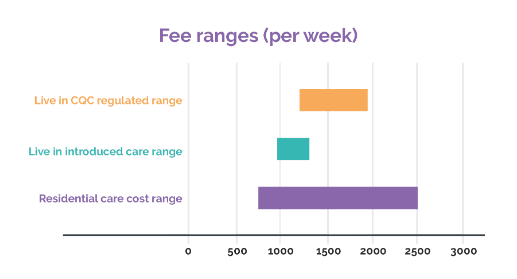 Live-in care is particulalry cost-effective when considering care for couples. Residential care can cost up to twice as much when you pay individually for each partner’s care. Conversely, live-in care offers a bespoke and cost-effective care plan based on the care of both partner’s needs.
An end to loneliness
Life is busy, especially when you’re juggling work, a young family and other family commitments. This can mean you do not have as much time as you’d like to spend with, or care for, your elderly relatives. Loneliness is a huge concern for many people. It can have serious effects on the health and wellbeing of the elderly. This was confirmed by research, commissioned by the Live-in Care Hub. High quality live-in companion care is the perfect solution for many families. They know their loved one is not only cared for but is no longer lonely. A live-in carer is always there to chat and engage with your loved one whenever they want. Just having that presence in their home can alleviate the feeling of loneliness.
Dignity and choice
 No matter how good a nursing home might be they are institutions and this means your loved one will lose some of their choices – even if it’s just small things like when you can have a cup of tea or what you’ll have for dinner. Losing your freedom to choose can impact on both physical and mental health but with live-in care your parent/loved one will benefit from staying in control for longer. They can decide when they want to get up, have a cup of tea, go out, see friends, and have dinner. Live-in care means that your loved one can:
- Have their privacy and preferences respected
- Get an immediate response to their needs
- Continue to visit and welcome friends and family
- Continue with hobbies or local community activities
- Keep their pets
- Remain with their partner.
Specialist care options
Just because your relative/parent needs specialist care doesn’t mean they can’t remain at home. Mumby’s has specialist carers who can care for people living with conditions like dementia, Parkinson’s or MS. We also support families where we can with insights into dealing with dementia.
Our complex care carers receive high-quality tailored carer training responsive to client care needs. We train our carers in nurse-led practises including:
• Stoma Care
• Nebulisers
• Oral Suction
• Topical Cream
• Transdermal Patches
• Inhalers
• Gastrostomy (supporting people with a PEG feed)
• Administering Ear and Eye drops
• Compression stockings
• Medications – Warfarin, buccal Midazolam (emergency medication for seizures).
A choice of managed or introductory live-in care for families

Mumby’s offers clients the choice of managed or introductory care depending on their preferences.
Managed care takes care of all aspects of the service, including prodcuing a care plan, employing andf managing carers and their training, automatically providing carer cover and a 24/7 on-call advice and support service. The managed service is CQC-regulated and Mumby’s are rated as Outstanding.
The introductory service appeals to clients who want flexibility, autonomy, and a lower price.Mumby’s has a pool of carers and they act as a matchmaking service, listening to the needs to clients and matching them to suitable carers who they introduce.
Both care services have a rigorous recruitment policy for our carers and match clients with carers based on their preferences and wishes.
Contact us – we’d love to hear from you
To discuss you individual needs and care options please call us today on 01865 391187 or email info@mumbys.com.
Useful Links
Seven Benefits of Live-in Care